
Openfor.co · Ecosystem
YC Summer 2026 Requests for Startups: An independent reading
Erdinc Ekinci · 7 May 2026 · 35 min read
An independent reading of YC's most consequential RFS in a decade.
By Erdinc Ekinci, Founding Partner, Co-Capital · MD of Founder Institute Japan, Korea, Taiwan · Founder of, Openfor.co - Published on May 7, 2026, Tokyo, Japan.
What I'm reading on YC's Summer 2026 list
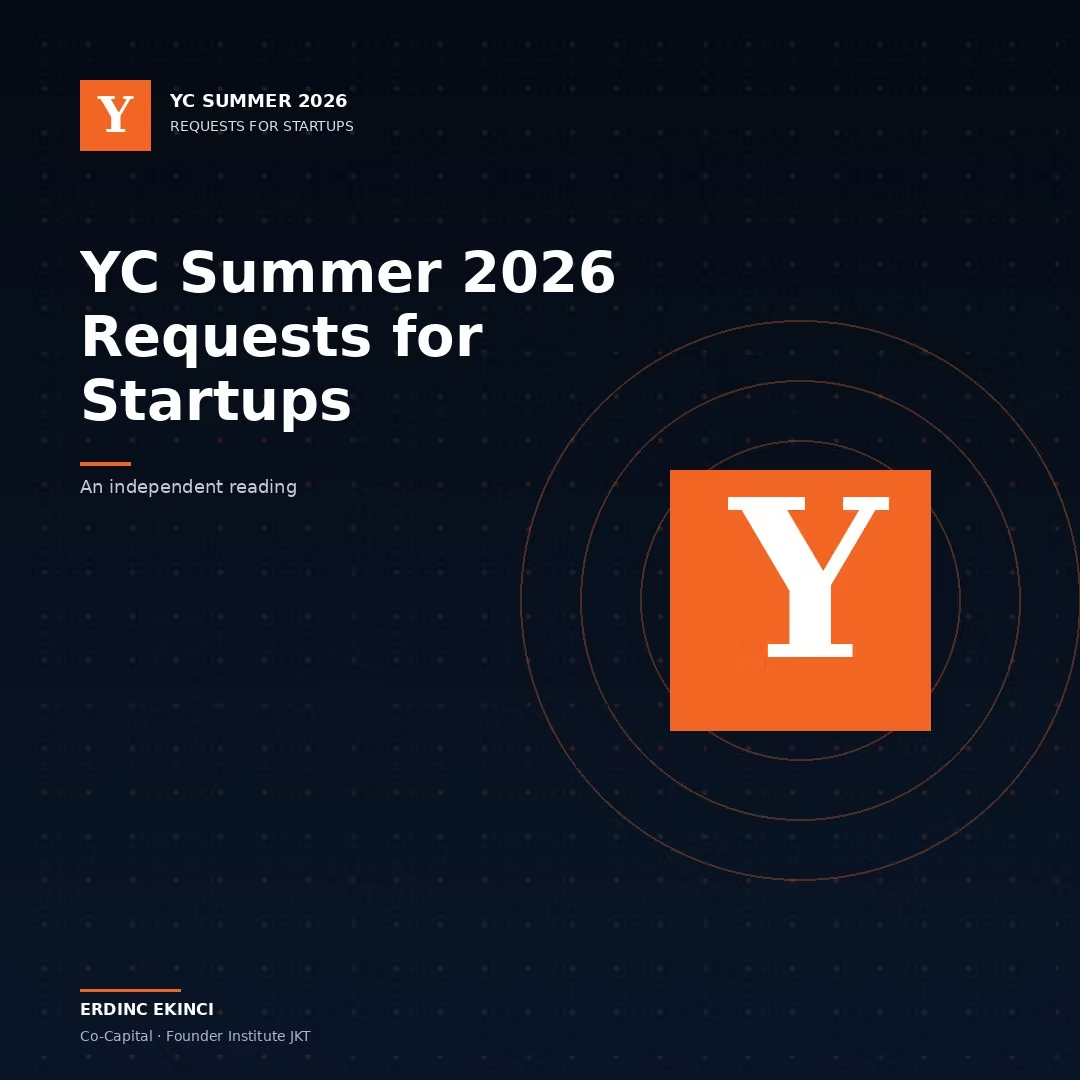
I read every YC Request for Startups when it drops. Most of them I skim. This one I read twice, then started pulling the threads, because the Summer 2026 edition is structurally different. It is the first YC RFS where more than half of the categories require capital, hardware, or both. It is the first to feature founder-authored entries from a portfolio company alongside partner-authored ones. And it is the first where a single partner, Diana Hu, owns three of the sixteen categories.
This report is what I built for myself, then decided to publish. It is journalistic, not promotional. Where YC has cited evidence, I quote them. Where they have not, I pull the most credible publicly available sources, including peer-reviewed papers, government filings, market research firms, and trade press. None of this is investment advice. None of it is a solicitation. It is reading material for founders, investors, and ecosystem builders trying to triangulate where serious capital is going next.
What's inside
Category
Partner
01
AI for Low-Pesticide Agriculture
Garry Tan
02
AI-Native Discovery Engines
Jon Xu
03
AI-Native Service Companies
Gustaf Alstromer
04
AI Personalized Medicine
Ankit Gupta
05
Company Brain
Tom Blomfield
06
Counter-Swarm Defense
Tyler Bosmeny
07
Dynamic Software Interfaces
Ankit Gupta
08
Electronics in Space
Philip Johnston (Starcloud)
09
Hardware Supply Chain
Nicolas Dessaigne
10
Industrial Capabilities in Space
Adi Oltean (Starcloud)
11
Inference Chips for Agent Workflows
Diana Hu
12
SaaS Challengers
Jared Friedman
13
Software for Agents
Aaron Epstein
14
Selling to Huge Companies
Arora & Flora
15
Supply Chain 2.0 for Semiconductors
Diana Hu
16
The AI Operating System for Companies
Diana Hu
A note on sources. YC's RFS does not include footnotes. Every direct quote from YC is attributed to ycombinator.com/rfs. Every other claim is attributed to a named third-party source. This document is editorial.
The shape of the list
Before going category by category, here is the structural read.
Hardware is back, and it is not subtle.
Eight of the sixteen categories require hardware, capital, or both: agriculture, drones, space chips, hardware supply chain, lunar manufacturing, agent inference silicon, semiconductor supply chain, and discovery engines. The Spring 2026 RFS, published just three months earlier, had eight categories total and was largely software. The Next Web, writing at the end of April 2026, called it "the most dramatic reorientation in YC's public investment thesis since the accelerator began publishing requests for startups."
YC is funding the substrate, the application, and the silicon at the same time.
The opening line of the RFS is the spine of the document: "AI has stopped being a feature and started being the foundation. We're excited about a new wave of startups rebuilding software, services, and silicon, and pushing AI into the physical world." Software shows up in five categories. Silicon shows up in three. Services shows up in two. The physical world (defense, agriculture, space, supply chain) shows up in five.
The numbers behind the list
16 categories on the Summer 2026 list (Source: ycombinator.com/rfs)
8 require hardware, capital, or both (Source: TheNextWeb, May 2026)
3 authored by Diana Hu — chips, supply chain, AI OS (Source: ycombinator.com/rfs)
2 authored by founders, not partners (Source: ycombinator.com/rfs)
How partner attention is concentrated
Partner
Categories owned
Diana Hu
3
Ankit Gupta
2
Starcloud (Johnston / Oltean)
2
Arora & Flora
1
All other partners
1 each (8 total)
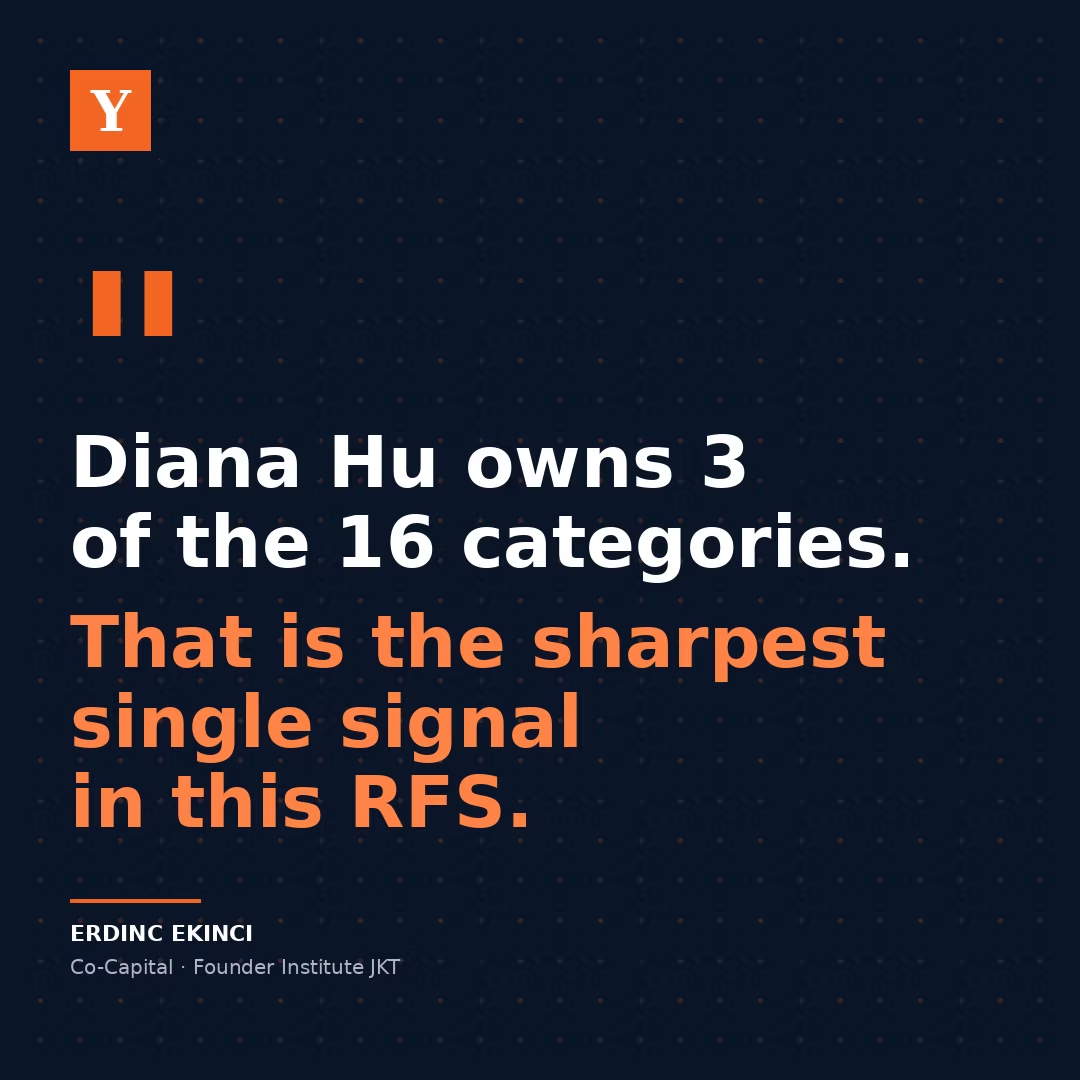
Diana Hu owning chips, semiconductor supply chain, and AI OS for companies is the sharpest single signal in this RFS. If you are working on any of the three, she is likely the partner reading your application.
What is missing compared to Spring 2026
YC's Spring 2026 list, three months ago, prioritized AI for product management, government AI, AI-native hedge funds, and stablecoins. None of those appear on the Summer list. Voice agents, AI receptionists, legal AI, robotics for consumers also do not appear. Their absence is not a verdict, but it is a signal of where partners are not currently spending time.
01. AI for Low-Pesticide Agriculture
Partner: Garry Tan, CEO of Y Combinator
Garry Tan wrote the longest piece on the list, and the most narrative. He is asking founders to fix the loop that is breaking modern agriculture: spray more chemicals, get diminishing returns, pay more, take on more risk. His pitch closes with a generational company line. The data behind that pitch is real, but the field is also crowded.
"The company that cuts pesticide use by 90% and helps farmers grow more food? That's not just a good business. That's a generational company." — Garry Tan, ycombinator.com/rfs
By the numbers
$56B projected agricultural robots market by 2030 (Source: MarketsandMarkets, 2025)
$100M+ Carbon Robotics ARR, FY ending Jan 2026 (Source: Machine Herald, March 2026)
95% herbicide reduction in peer-reviewed robotic spot-spraying trials (Source: Zhang et al., 2022, via NC State Extension)
15 countries where Carbon Robotics' LaserWeeder is deployed (Source: carbonrobotics.com)
What YC is actually pointing at
Tan's three enabling technologies are AI vision, cheap sensors and cameras, and precision robotics that can treat single plants. He adds biology, including microbes, peptides, and RNA-based solutions, as the second leg. The combination of plant-by-plant targeting plus non-chemical alternatives is the thesis.
The market is at a commercial threshold, not a starting line
Machine Herald reported in March 2026 that Carbon Robotics surpassed USD 100 million in annual revenue, Solinftec deployed more than 100 autonomous robots across American farms, and Swiss B-Corp Ecorobotix sold its 1,000th ARA ultra-high-precision sprayer. Carbon Robotics' marketing pages cite a Large Plant Model trained on 150 million labelled plant images. Ecorobotix's own collateral claims up to 95 percent herbicide reduction with subcentimeter accuracy in vegetable and specialty crops, scanning and spraying in 250 milliseconds.
The biology is real, but it has limits
Tan's mention of RNA-based solutions is the most novel piece of his thesis. The U.S. EPA registered Ledprona, the active ingredient in GreenLight Biosciences' Calantha biopesticide, in late 2023. EPA's own statement: ledprona uses RNA interference to silence a gene the Colorado potato beetle needs to produce the PSMB5 protein, with no genetic modification of the crop.
Science magazine reported in 2024 that GreenLight could produce 2 tons of dsRNA per year at sub-USD 1 per gram, with capacity targeted at 20 tons by end of 2025. The same article notes a real limit: lepidopterans, which include diamondback moth and many other major pests, have gut enzymes that break down RNA before it can act. The technology works well for beetles. It does not yet work well for most caterpillars.
What I'm watching for
John Deere acquired Blue River Technology back in 2017. The incumbent equipment maker now has its own See & Spray product line. A YC two-person team is entering a market where the leading commercial player has crossed USD 100 million in revenue and Deere has the dealer network.
Most of the proven economic ROI is in specialty crops like lettuce, spinach, sugar beets. Ecorobotix itself notes its sprayer is more suitable for small organic operations than large conventional row crops. The mass commodity market is harder.
EPA registration timelines remain the gating factor for biological alternatives. Ledprona's three-year registration is up for review.
Key sources for this section
U.S. EPA. EPA Registers Novel Pesticide Technology for Potato Crops
Science magazine. The perfect pesticide? RNA kills crop-destroying beetles, 2024
Machine Herald. Agricultural Robots Cross the Commercial Threshold, March 2026
MarketsandMarkets. Agriculture Robots Market Report 2025-2030
NC State Extension. AI-enabled Robotic Weeders in Precision Agriculture
carbonrobotics.com; ecorobotix.com (company-published claims)
02. AI-Native Discovery Engines
Partner: Jon Xu, YC partner
This is the category that was missing from the screenshot floating around social media. Xu is asking for systems that close the scientific loop, not copilots that help researchers do their jobs. The frontier is shifting from suggestion to autonomy, and the existing examples are all in narrow domains.
"The companies that make meaningful contributions to scientific progress won't just sell research copilots. They'll be AI-native discovery engines that work alongside researchers to propose and validate hypotheses." — Jon Xu, ycombinator.com/rfs
By the numbers
PhD-level performance frontier models now reach on scientific reasoning benchmarks (Source: ycombinator.com/rfs)
10x data collection speed-up from NC State's flow-driven self-driving lab (Source: Nature Chemical Engineering, July 2025)
$4B Recursive Superintelligence valuation 4 months after founding (Source: Financial Times via Fortune, April 2026)
3 domains where closed loops already work: drug discovery, materials, protein engineering (Source: ycombinator.com/rfs)
What YC is actually pointing at
Xu's framing distinguishes "AI-native discovery engines" from "research copilots." The difference is autonomy. A copilot suggests; a discovery engine proposes hypotheses, generates experiments, runs them through automated labs, analyzes the results, and feeds them back into the next hypothesis. He cites three domains where this already happens at small scale.
The technology is real and accelerating
A July 2025 review in Royal Society Open Science concluded that the most capable self-driving labs already automate "nearly the entire scientific method." In July 2025, NC State researchers published a flow-driven data intensification technique in Nature Chemical Engineering that allows self-driving labs to collect at least 10 times more data than previous techniques. ChemAgents, a multi-agent LLM-based system featuring a Task Manager that coordinates Literature Reader, Experiment Designer, Computation Performer, and Robot Operator agents, was published in 2025.
The capital is there
Recursive Superintelligence, founded in late 2025 by Richard Socher, Tim Rocktaschel, Jeff Clune, Josh Tobin, and Tim Shi, raised at least USD 500 million at a USD 4 billion valuation in early 2026 with Google's GV leading and Nvidia participating. FutureHouse, philanthropy-funded since late 2023, is building "AI Scientists" for biological research. MicroCycle, launched 2024, is described in the SDL review as "perhaps the best-in-class platform for rapidly identifying and obtaining multidimensional data on pharmaceutical lead compounds."
What I'm watching for
Most commercial scientific AI today is still in the copilot category, not the discovery-engine category. The transition Xu describes is demonstrated narrowly.
Schrodinger has been public since 2020. Recursion acquired Exscientia in 2024. Insitro, Owkin, Iambic. The incumbents in computational drug discovery have data and capital advantages that startups have to overcome.
Closed-loop discovery requires automated wet labs. Founders without access to lab capital will struggle to demonstrate the loop.
Key sources for this section
Royal Society Open Science. Autonomous self-driving laboratories: a review, July 2025
Nature Chemical Engineering, Delgado-Licona et al., July 2025
ScienceDaily summary of NC State's self-driving lab paper
Fortune Eye on AI on Recursive Superintelligence, April 2026
arXiv 2504.00986: Artificial whole-lab orchestration for drug discovery
03. AI-Native Service Companies
Partner: Gustaf Alstromer, YC partner
This is the most crowded thesis on the list. General Catalyst has put USD 1.5 billion behind it. Mayfield, Sequoia, and Elad Gil have been investing in the same idea for two-plus years. YC's contribution is to point its founders at the same opportunity.
"AI-native companies that don't sell software, they sell the service. Instead of giving you a tool, they just do the work." — Gustaf Alstromer, ycombinator.com/rfs
By the numbers
$16T annual global services revenue, the addressable market (Source: Marc Bhargava, General Catalyst, via TechCrunch Sept 2025)
80-90% achievable gross margin if 80% of work is automated by AI (Source: Navin Chaddha, Mayfield, via TechCrunch Sept 2025)
$49.2B generative AI VC investment in H1 2025 (already exceeded all of 2024) (Source: VC Cafe, September 2025)
4 industries YC explicitly names: insurance, accounting, compliance, healthcare admin (Source: ycombinator.com/rfs)
What YC is actually pointing at
Alstromer's argument is structural. Historically, services became SaaS. Then SaaS became copilots. Now, AI-native companies sell the finished service itself. He calls out four industries: insurance brokerage, accounting and tax and audit, compliance, and healthcare administration.
Capital has flooded this thesis already
General Catalyst's Marc Bhargava told TechCrunch in September 2025 that the firm has dedicated USD 1.5 billion of its latest fundraise to a "creation" strategy: incubate AI-native companies in specific verticals, then use them as acquisition vehicles to buy established firms in the same sector. GC has placed bets across seven industries with plans to expand to 20. Mayfield carved out USD 100 million for "AI teammates" investments. Solo investor Elad Gil has been pursuing the same strategy for three years. Sequoia partner Julien Bek's "Services: The New Software" thesis went viral in 2025 and was profiled by Fortune in April 2026.
Practitioners are already shipping
In accounting alone, the field is dense: Puzzle (startup-focused, Stripe / Mercury / Brex / Ramp integrations), Campfire (mid-market AI-native ERP, claims customers scaling from USD 10M to USD 200M+ ARR without growing the accounting team), Zeni, Truewind, Numeric, DualEntry. Andreessen Horowitz's January 2025 fintech newsletter explicitly argued that vertical AI in accounting beats horizontal AI because each industry has bespoke logic for revenue recognition, billing, and reconciliation.
What I'm watching for
Uncover Alpha's "Great SaaS Unbundling" essay made the sharpest counter-argument I have read: deterministic systems (accounting, ERP, compliance, claims) need 100 percent consistency, but LLMs are probabilistic. The four target industries YC names are all heavily deterministic.
TechCrunch's reporting flagged the difficulty of the rollup-plus-AI strategy in practice: integration and culture challenges in acquired services firms are real and slow.
If General Catalyst, Sequoia, Mayfield, and Elad Gil have been competing for these deals for three years, the cap table is already crowded by the time YC's founders show up.
Key sources for this section
TechCrunch. The AI services transformation may be harder than VCs think, September 2025
Fortune Eye on AI. Sequoia partner thinks AI-enabled services are the new software, April 2026
VC Cafe. AI Startups attacking the $4 Trillion Services Sector, September 2025
a16z fintech newsletter. The Rise of Vertical AI in Accounting, January 2025
Uncover Alpha. The Great SaaS Unbundling, February 2026
04. AI Personalized Medicine
Partner: Ankit Gupta, YC partner
Two collapses are happening simultaneously: the cost of personalized diagnostics and the cost of n-of-1 genetic therapies. The FDA has been signaling, throughout 2025 and into early 2026, that it is ready to make individualized therapies a recognized regulatory pathway. Founders are walking into a regulatory door that was closed a year ago.
"We can now use an agent harness like Claude Code to analyze personalized health data, whether that be a diagnostic test, genome scan, EHR data, or wearables information to get highly accurate, user-specific suggestions." — Ankit Gupta, ycombinator.com/rfs
By the numbers
Faster than Moore's Law rate at which genome sequencing cost is falling (Source: ycombinator.com/rfs, industry consensus)
Feb 2026 FDA published guidance specifically for individualized therapies (Source: BioPharma Dive, February 2026)
ASOs first class with explicit FDA tailored regulatory advice for individual drugs (Source: Therapeutic Innovation & Regulatory Science, Feb 2025)
Yes CURATE.AI has been used to optimize n-of-1 prostate cancer dosing in published case reports (Source: PMC8873079)
What YC is actually pointing at
Gupta's thesis has three legs. First, intelligent agents (he names Claude Code as an example) can now reason over personalized health data. Second, the cost of generating personalized diagnostics is plummeting. Third, the cost of "printing n-of-1 genetic therapies" through delivery vectors like mRNA is plummeting, and the FDA has expressed openness.
The FDA is moving
BioPharma Dive reported in February 2026 that the FDA fleshed out a roadmap specifically for individualized therapies. The agency's framing, captured in BioPharma Dive's reporting, is unusually direct: "The types of individualized genetic therapies that we're trying to develop simply do not fit in the traditional model of drug development." The 2025 "Platform Technology Designation" draft guidance set up the framework: a platform is defined not by identical payloads, but by a consistent framework that supports a range of variant-specific interventions without rebuilding from scratch. mRNA vaccines, AAV gene therapies, and CAR-T qualify.
There is published evidence the AI-driven dosing works
A peer-reviewed paper profiled CURATE.AI dynamically optimizing combination therapy for an 82-year-old metastatic castration-resistant prostate cancer patient based on weekly PSA measurements. The Quadratic Phenotypic Optimization Platform (QPOP) was used to optimize drug combinations against multiple myeloma from a pool of 114 candidates. These are real cases, not lab demos.
What I'm watching for
FDA openness is contingent on administration policy. A change in regulatory leadership can close the window.
n-of-1 ASOs and gene therapies still cost millions of dollars per patient. Patient-affordable n-of-1 therapy is years away.
The NAACP released a 75-page report in late 2025 calling for equity-first standards in health AI. Bias audits and community governance are coming.
Liability and reimbursement frameworks for AI-assisted personalized therapy are nascent. Founders should expect to operate without case law.
Key sources for this section
BioPharma Dive. FDA fleshes out new roadmap for testing personalized therapies, February 2026
Revvity. From policy to practice: what FDA's 2025 direction means for your precision medicine pipeline
Therapeutic Innovation & Regulatory Science, Bou-Jaoudeh et al., February 2025 (DOI 10.1007/s43441-025-00752-8)
NCBI/PMC. N-of-1 Healthcare: Challenges and Prospects
Top Doctor Magazine. Personalized Medicine Trends 2026, March 2026
05. Company Brain
Partner: Tom Blomfield, YC partner (Monzo, GoCardless)
Blomfield's framing is the sharpest "missing primitive" argument on the list. He is not asking for enterprise search. He is not asking for a chatbot over documents. He is asking for an executable skills file that AI agents can actually use to run a company.
"We need Garry's G-Brain, but for every business in the world. A system that pulls knowledge out of all these fragmented sources, structures it, keeps it current, and turns it into an executable skills file for AI." — Tom Blomfield, ycombinator.com/rfs
By the numbers
$7.2B Glean valuation after $150M Series F in 2025 (Source: Top Startups, 2026)
164M+ monthly downloads of MCP Python SDK on PyPI by April 2026 (Source: Truthifi State of MCP 2026)
~150 member organisations in Linux Foundation's Agentic AI Foundation by April 2026 (Source: Truthifi State of MCP 2026)
Subject-Predicate-Object Glean's knowledge graph triplet structure (Source: phData, November 2025)
What YC is actually pointing at
Blomfield's diagnosis is that the bottleneck for AI automation is no longer model quality, it is domain knowledge. Every company has critical know-how scattered across people's heads, old emails, Slack threads, support tickets, and databases. He explicitly distinguishes the company brain from existing solutions: "This isn't a company-wide search or a chatbot over documents. It's a living map of how a company works: how refunds get handled, how pricing exceptions are decided or how engineers respond to incidents."
Glean is the most-cited reference, and it is a giant already
phData's November 2025 piece on "How to Create a Company 'Brain' with Glean" describes Glean's approach as a Knowledge Graph: a structured machine-readable abstraction layer connecting people, documents, tools, and projects through subject-predicate-object triplets. Glean closed a USD 150 million Series F in 2025 at a USD 7.2 billion valuation.
The protocol layer is now standardized
Anthropic's MCP, formed in November 2024, has gone from 100,000 downloads to 164 million monthly Python SDK downloads by April 2026, per Truthifi's State of MCP 2026 report. The Linux Foundation's Agentic AI Foundation, formed December 2025, has nearly 150 member organisations including Amazon, Anthropic, Block, Bloomberg, Cloudflare, Google, Microsoft, and OpenAI as platinum members. Anthropic's own engineering blog published a piece on "Code execution with MCP" in late 2025 that articulates the technical pattern Blomfield's executable skills file framing implies.
What I'm watching for
Microsoft (Copilot), Google (Gemini for Workspace), and ServiceNow are all chasing the same outcome from incumbent positions with massive distribution advantages.
A company brain that actually executes against systems requires write-access. Permission management, audit trails, and what happens when the brain is wrong are mostly unsolved.
Most enterprise search and assistant products today are read-only. Going write-mode crosses an enterprise risk threshold.
Key sources for this section
phdata.io. How to Create a Company 'Brain' with Glean, November 2025
Truthifi. The State of MCP 2026: AI Agents, OAuth, and Your Money
Linux Foundation Press release on Agentic AI Foundation, December 2025
06. Counter-Swarm Defense
Partner: Tyler Bosmeny, YC partner (Clever)
Bosmeny's piece is the most provocative on the list. He argues that the cost asymmetry has fundamentally broken air defense, and that the winning companies will look more like Cloudflare than Raytheon. The market data backs the cost argument. The political and procurement environment makes the Cloudflare comparison harder to operationalize.
"A Patriot missile costs three million dollars. An FPV drone? Five hundred bucks. All of the cost advantage lies with the attackers. We are not ready." — Tyler Bosmeny, ycombinator.com/rfs
By the numbers
$3.1B → $18.9B counter-UAS market, 2025 to 2034, at 21.5% CAGR (Source: Marketintelo, 2026)
$700M U.S. Army Joint C-UAS Office contracts awarded in 2025 (Source: Marketintelo, citing JCO procurement)
$2,100 cost of Ukraine's Wild Hornets Sting interceptor (Source: New Atlas, May 2026)
$500K reported cost of Anduril's Roadrunner interceptor (per unit) (Source: Inside Unmanned Systems, January 2026)
What YC is actually pointing at
Bosmeny's specific product asks: high-capacity interceptors that neutralize 50 drones in one platform; software that fuses every sensor and every defender into a single real-time picture; non-kinetic defenses including aerosols and streamers; and new attacks on the autonomy stack itself, since radio jamming is becoming obsolete. His framing: drone defense is becoming a real-time distributed system problem.
The cost asymmetry is real and well-documented
CSIS published "Calculating the Cost-Effectiveness of Russia's Drone Strikes" in December 2025, working with the University of Texas. CSIS confirms Bosmeny's framing: even though Shahed drones hit their target less than 10 percent of the time, the low cost lets Russia fire mass salvos almost daily. CSIS's conclusion: "The United States struggles to field a comparable, cost-effective mix of capabilities for ground-based air defense capable of covering a 1,000 km front."
Inside Unmanned Systems noted in January 2026 that Anduril's Roadrunner interceptor reportedly costs around USD 500,000 each, while Ukrainian-built FPV interceptors cost low single-digit thousands. The CNAS think tank's "Countering the Swarm" study by Stacie Pettyjohn and Molly Campbell concludes the U.S. "lacks sufficient purpose-built counter-drone systems, large reserves of affordable interceptors, and a modern short-range air defense capacity."
The incumbent landscape is well-capitalised
Anduril's Lattice software won an USD 87 million contract in March 2026 to serve as the C2 backbone of an Army deal that could potentially reach USD 20 billion over the next decade, per Breaking Defense. Shield AI raised USD 1.5 billion Series G in late 2025 at a USD 12.7 billion valuation. The top eight C-UAS vendors collectively account for 52 to 55 percent of the market. Rafael's Drone Dome is fielded in over 15 countries. Ukraine itself is now a major exporter of counter-drone tech, including Bukovel-AD and Sky Map.
What I'm watching for
YC has historically not been a major defense backer. Anduril, Shield AI, Epirus were funded by Founders Fund, a16z, General Catalyst. Selling to DoD requires program-of-record style integration that consumes years of runway.
Bosmeny's "Cloudflare not Raytheon" framing invites software-first founders. The risk: drone defense at scale increasingly needs kinetic effectors. Hardware is unavoidable.
Founders should expect their fundraising and hiring to be affected by ITAR, CFIUS, FOCI, and sovereign procurement rules.
Key sources for this section
CSIS. Calculating the Cost-Effectiveness of Russia's Drone Strikes, December 2025
CNAS. Countering the Swarm, Pettyjohn and Campbell
Inside Unmanned Systems. 2025 Proved the Case for Drone Defense, January 2026
Marketintelo. Counter-UAS Drone Defense System Market Research Report 2034
New Atlas. Ukraine's rapid rise as an anti-drone powerhouse, May 2026
07. Dynamic Software Interfaces
Partner: Ankit Gupta, YC partner
Every user is the same to most software. The exception was enterprise, where forward-deployed engineers customized for each customer. Gupta's argument: coding agents now let every user become their own forward-deployed engineer. The protocols to make this work are crystallizing in real time.
"We think that coding agents have now gotten good enough to allow users to become their own forward deployed engineers and more radically customize the software they consume." — Ankit Gupta, ycombinator.com/rfs
By the numbers
AG-UI Microsoft's protocol for bidirectional agent-user interaction (Source: CopilotKit / Microsoft documentation)
A2UI Google's declarative JSONL-based generative UI spec (Source: GitHub: CopilotKit/generative-ui)
Open-JSON-UI Open standardization of OpenAI's internal generative UI schema (Source: GitHub: CopilotKit/generative-ui)
MCP Apps Anthropic's protocol for open-ended generative UI (Source: Anthropic / Linux Foundation)
What YC is actually pointing at
Gupta gives a concrete example: "perhaps my email client looks more like a task list, and a students' looks more like an events calendar." He raises three open architectural questions: how to deliver software so user coding agents can modify it (source code vs binaries); whether modifications are limited to front-end visual elements or include middleware; and how the entire stack of software delivery has to change.
The category has a name now: Generative UI
InfoWorld captured the framing in January 2026: "The advent of MCP APIs hints at a coming era of agent-driven architecture. In this architecture, the chat interface becomes the front end and creates UI controls on the fly." CopilotKit identifies three patterns: Static Generative UI (pre-built components, agent picks; via AG-UI), Declarative Generative UI (agent returns structured spec; via A2UI and Open-JSON-UI), and Open-ended Generative UI (agent generates arbitrary HTML; via MCP Apps).
Enterprise applications are emerging
A December 2025 piece on "Agentic UI in the Enterprise" walked through implementations using Microsoft Agent Framework with Flutter and React clients. The key principle the author surfaced: "LLM proposes UI intent; platform enforces rules; trusted renderer displays only approved components." Bessemer's December 2025 "AI systems of action" roadmap profiled Doss, an AI-native ERP that lets users describe workflows and UI in natural language.
What I'm watching for
InfoWorld's January 2026 critique was direct: generative UI today still requires the developer to do most of the engineering. "There is something here, but I don't see genUI replacing UX and UI engineers anytime soon."
Brand consistency, security and sandboxing, and native (non-web) platforms are unsolved.
The architecture may be settled by protocols rather than products. Founders should pick their layer carefully.
Key sources for this section
InfoWorld. Generative UI: The AI agent is the front end, January 2026
CopilotKit documentation. Generative UI: Understanding Agent-Powered Interfaces
GitHub: CopilotKit/generative-ui
Bessemer Venture Partners. Roadmap: AI systems of action, December 2025
08. Electronics in Space
Partner: Philip Johnston, Founder & CEO of Starcloud (YC S24)
This is one of two founder-authored entries on the list. Johnston runs Starcloud, which became a unicorn in March 2026, just 17 months after YC demo day. He is asking founders to design specialized inference chips for orbital deployment. The launch-cost trajectory makes the thesis credible. The timeline makes it patient capital.
"We are about to see an absolutely huge increase in the capacity that humanity has to put things in space because of reusable rockets from SpaceX and Stoke Space. This means that we're going to need enormous amounts of new compute capacity in space." — Philip Johnston, Starcloud, ycombinator.com/rfs
By the numbers
$1.1B Starcloud valuation at March 2026 Series A (Source: TechCrunch, March 2026)
$200M Starcloud total raised across seed and Series A (Source: TechCrunch, March 2026)
100x power of H100 vs any GPU previously launched to space (Source: Starcloud, via CNBC)
5GW Starcloud's long-term orbital hypercluster target (Source: Spectral Reflectance, November 2025)
What YC is actually pointing at
Johnston's spec is precise: "slightly optimized for mass, slightly optimized for thermal, and slightly optimized for radiation." His call to action is targeted: chip designers from SpaceX or NVIDIA. This is not a request for software. It is a request for silicon designed specifically for orbit.
Starcloud's own milestones validate the thesis
Starcloud-1 launched in November 2025 carrying a single Nvidia H100, described by the company as 100x more powerful than any GPU previously operated in space. It became the first satellite to train an LLM in orbit (NanoGPT trained on Shakespeare) and the first to run a version of Gemma in orbit. Starcloud raised a USD 170 million Series A at a USD 1.1 billion valuation in March 2026, led by Benchmark and EQT Ventures. Starcloud-2, planned for October 2026, will feature multiple GPUs including a Blackwell chip and an AWS server, plus a Crusoe Cloud module for customers.
The competitive landscape is broad and deep-pocketed
Lonestar Data Holdings is targeting a Q4 2026 LEO launch and lunar data centers. Aetherflux (founded by ex-Robinhood CEO Baiju Bhatt) is targeting Q1 2027. Aethero launched Nvidia's first space-based Jetson GPU in 2025. Google's Project Suncatcher will launch two prototype satellites with TPUs in early 2027. Axiom Space is integrating orbital data center capability into Axiom Station. ADA Space (China) is building a 2,800-satellite distributed supercomputer in LEO. SpaceX has asked the U.S. government for permission to build a million satellites for distributed compute.
What I'm watching for
Hypercluster economics depend on Starship-class launch vehicles entering routine commercial service. Without it, mass-launch costs dominate.
Johnston himself told TechCrunch that the H100 is "probably not the best chip for space." Specialized chips for orbit need rad-hardening, thermal management for vacuum, and mass optimization that current chips do not have.
The overall capex requirements push founders into Series A relationships with Lux, Founders Fund, Benchmark, EQT, Sequoia. YC's USD 500K SAFE is a starting point, not a finish line.
Key sources for this section
TechCrunch. Starcloud raises $170 million Series A to build data centers in space, March 2026
CNBC. Nvidia-backed Starcloud trains first AI model in space, December 2025
Spectral Reflectance. The Cloud's Final Frontier: Orbital Data Centers, November 2025
Blocks and Files. Starcloud pitches orbital datacenters, October 2025
09. Hardware Supply Chain
Partner: Nicolas Dessaigne, YC partner (Algolia)
Dessaigne's argument is straightforward: in Shenzhen, hardware iteration takes a day. In the U.S., it takes weeks. Whoever closes the gap captures the next generation of hardware companies. He explicitly names two YC portfolio companies as starting points: Hlabs and Prototyping.io.
"We believe the next generation of great hardware companies will be built on much faster iteration loops." — Nicolas Dessaigne, ycombinator.com/rfs
By the numbers
3 months Shenzhen prototype-to-mass-production timeline (Source: Easelink Tech, March 2026)
6-9 months Western equivalent timeline (Source: Easelink Tech, March 2026)
100,000+ electronics enterprises within 50km of Shenzhen (Source: Easelink Tech, March 2026)
Weeks vs Days Dessaigne's stated US-vs-China iteration gap (Source: ycombinator.com/rfs)
What YC is actually pointing at
Dessaigne's three startup categories: produce parts dramatically faster; enable rapid hardware iteration; tightly integrate design, manufacturing, and logistics. He explicitly names Hlabs (W26, building actuators) and Prototyping.io (P26, design-to-mechanical-parts in days) as examples of progress.
The gap is well-documented
Easelink Tech in March 2026 quantified the gap: from prototype verification to mass production takes 3 months in China versus 6 to 9 months in Western countries. Shenzhen houses over 100,000 electronics enterprises within a 50 km radius covering chips, sensors, batteries, and structural parts. Huaqiangbei Electronics Market is consistently cited as the world's most concentrated component sourcing hub. The Diamandis Lab writeup on Shenzhen describes "hundreds of factories capable of turning product batches from prototypes in a few days."
U.S. policy response is not enough on its own
The CHIPS Act, the Department of Defense's Replicator Initiative, and federal funding for new fabs in Arizona, Texas, Ohio, and New York are all attempting to bridge the gap. Dessaigne's framing assumes startups are needed because policy alone is not sufficient. Recent tariff and trade policy creates uncertainty for startups depending on Chinese components.
What I'm watching for
The U.S. ecosystem has structural deficits beyond software: skilled assembly labor, dense supplier networks, factory-floor iteration tolerance. A startup providing parts faster still depends on someone making the parts.
The bottleneck may not be company-shaped. It may be a 20-year industrial-policy problem.
Tariffs on Chinese components create unpredictable cost structures for hardware startups.
Key sources for this section
Easelink Tech. US Smart Hardware Startup China Sourcing, March 2026
Diamandis Lab. Shenzhen: Hardware Capital of the World
ITI Manufacturing. Why Shenzhen is the Silicon Valley of China, November 2025
FDI China. Why Shenzhen is the World's Best Destination for Prototyping, February 2025
10. Industrial Capabilities in Space
Partner: Adi Oltean, Founder & Chief Engineer of Starcloud
The shortest entry on the list, and the most aspirational. Oltean is pointing at lunar in-situ resource utilization: extracting silicon, aluminum, iron, and titanium through electrolysis, and 3D printing complex structures from molten regolith. NASA already runs a program for this. The technology readiness level is low. The timeline is years, not quarters.
"Developing industrial capabilities on the moon and in space, particularly extracting raw materials such as silicon, aluminum, iron, and titanium through electrolysis and 3D printing of complex structures from molten regolith on the moon, which should be more efficient than on Earth due to lack of supports." — Adi Oltean, Starcloud, ycombinator.com/rfs
By the numbers
MMPACT NASA's Moon-to-Mars Planetary Autonomous Construction Technology project (Source: Microscopy and Microanalysis, July 2025)
VMX NASA & ICON's vitreous multi-material transformation laser 3D-printing method (Source: Microscopy and Microanalysis, July 2025)
Yes iron successfully microbially extracted from lunar regolith simulants for 3D printing (Source: bioRxiv preprint)
17.4V open-circuit voltage from a 3D-printed lunar regolith triboelectric nanogenerator (Source: PMC, January 2026)
What YC is actually pointing at
Oltean's framing is specific: lunar in-situ resource utilization through electrolysis and 3D printing. The note that printing complex structures should be more efficient on the Moon than Earth, due to the absence of gravity-induced supports, is a real engineering observation.
The science is published and active
A 2026 study reported in phys.org showed simulated lunar regolith (LHS-1) can be 3D printed into durable, heat-resistant structures using laser-based methods. NASA, with ICON Technologies, is developing vitreous multi-material transformation under MMPACT. NASA Kennedy Space Center and Sidus Space hold a joint patent (KSC-TOPS-88) for a regolith-polymer 3D print head. A January 2026 paper demonstrated a triboelectric nanogenerator fabricated using lunar regolith simulant via 3D printing, delivering 17.4 volts open-circuit. Microbial extraction of iron from lunar and Martian regolith simulants for 3D printing has also been demonstrated in published preprints.
What I'm watching for
Technology readiness level remains low. Most demonstrations are with regolith simulants, not actual lunar regolith.
First commercial test of any of these technologies in space is years away.
Capital intensity is extreme. Revenue paths near term are limited to government and research contracts.
This is the single most patient-capital entry on the list. It is aimed at founders already in the space industry.
Key sources for this section
phys.org. Using moon dirt with 3D printing to build future lunar colonies, February 2026
Microscopy and Microanalysis, Abbott et al., July 2025
ScienceDirect. 3D printing LDPE/lunar regolith simulant composite, September 2025
NASA Technology Transfer Portal. Patent KSC-TOPS-88
PMC. Moon Regolith Simulant-Based All-3D-Printed Triboelectric Nanogenerator, January 2026
11. Inference Chips for Agent Workflows
Partner: Diana Hu, YC partner
Hu's most technically detailed piece. Her core observation: agents loop, branch, backtrack, hold context across dozens of steps. Current GPUs hit 30 to 40 percent of peak utilization on these workloads. Nvidia bought Groq for USD 20 billion because it saw exactly this coming.
"Groq's real insight wasn't the chip. It was the compiler that made the chip work. We think that'll be true for whoever builds this next." — Diana Hu, ycombinator.com/rfs
By the numbers
$20B Nvidia's December 2025 deal value for Groq's tech and team (Source: IntuitionLabs, December 2025)
3 GW OpenAI's allocated capacity for the new Nvidia-Groq inference chip (Source: Awesome Agents, March 2026)
80 TB/s Groq LPU memory bandwidth, ~10x H100 (Source: Awesome Agents, March 2026)
35x inference throughput per megawatt of new NVIDIA Groq 3 LPX vs prior (Source: NVIDIA Developer Blog, April 2026)
What YC is actually pointing at
Hu's design spec for agent silicon: fast context switching between models, native speculative decoding, memory built for KV caches that persist across an entire execution graph. She frames the agent loop itself as a hardware problem distinct from prompt-in / response-out inference.
Nvidia's acquisition validates the thesis
Multiple sources confirm Nvidia agreed to a deal valued at approximately USD 20 billion in December 2025 to license Groq's inference technology and acquire much of its engineering team, including founder Jonathan Ross. The deal was structured as a non-exclusive license plus acqui-hire to avoid triggering merger review. The result, announced at GTC 2026, is the NVIDIA Groq 3 LPX, designed specifically for agentic workloads. NVIDIA's own technical blog claims up to 35x higher inference throughput per megawatt and 10x more revenue opportunity for trillion-parameter models.
OpenAI was the lead customer for the new chip, allocating 3 GW of dedicated inference capacity. The Wall Street Journal reported that OpenAI engineers working on Codex found Nvidia's GPU-based inference "too power-hungry and too slow" for real-time, latency-sensitive workloads.
The architectural divide
Groq's LPU uses on-chip SRAM, deterministic compiler-orchestrated execution, and avoids "wasted cycles" through static scheduling. Independent benchmarks by Artificial Analysis showed Groq served 877 tokens/sec for Llama 3 8B and 284 tokens/sec for Llama 3 70B, roughly 2x the throughput of fastest alternatives. Google announced TPU 8i in April 2026, dedicated to inference, with 384 MB SRAM per chip.
What I'm watching for
Hu names Groq's compiler insight as the core lesson. A new entrant designing for agent loops needs a defensible architectural insight that survives Nvidia, Google, AMD, Cerebras, and the wave of AI ASIC startups.
Capital required to design and tape out a new chip is hundreds of millions. YC is implicitly seeking founders with very specific personnel and assuming partnership with deep-pocketed VCs after YC.
Cerebras (wafer-scale, IPO late 2025), SambaNova, and AMD remain credible competitors. Etched, MatX, Tenstorrent are venture-backed startups attacking the same problem.
Key sources for this section
NVIDIA Developer Blog. Inside NVIDIA Groq 3 LPX, April 2026
IntuitionLabs. Nvidia's $20B Groq Acquisition, December 2025
Awesome Agents. NVIDIA's Secret Chip Fuses GPU and Groq for OpenAI, March 2026
CNBC. Google unveils chips for AI training and inference, April 2026
12. SaaS Challengers
Partner: Jared Friedman, YC partner
Friedman's argument is bold: investors have wiped trillions off software market caps, and that is good news for startups. The replacement opportunity is the biggest in a decade. He explicitly tells founders to think bigger than project management tools and go after chip design software, ERPs, industrial control, supply chain.
"The next generation will be built by replacing legacy SaaS with AI-native software." — Jared Friedman, ycombinator.com/rfs
By the numbers
55% U.S. CIOs anticipating replacing some commercial software with AI-generated tools (Source: Recognize survey, late 2025)
54% CIOs actively running vendor consolidation programs (Source: Same Recognize survey, via SaaStr)
$150M ARR Sierra (Bret Taylor / Clay Bavor) <2 years post-launch (Source: Startup Fortune, May 2026)
35% point-product SaaS tools Gartner expects replaced by AI agents by 2030 (Source: Deloitte Insights, February 2026)
What YC is actually pointing at
Friedman outlines a spectrum: clone an existing product at one-tenth price, AI-native rebuild from scratch, bundle 10 SaaS point solutions into a suite, or open-source replacement monetized through services. His targets: "chip design software, ERPs, industrial control systems, supply chain management. The giant, 10-million-line codebases that have been untouchable for decades."
The market is in active rotation
A November 2025 Recognize survey of over 200 U.S. IT executives found 55 percent anticipate replacing some commercial software with AI-generated tools. SaaStr's analysis: "More than half of your enterprise customers are not just evaluating whether to switch vendors, they are running active programs to reduce the number of vendors they work with." Gartner's October 2025 customer service survey found 91 percent of leaders are under pressure to implement AI in 2026.
Capital is concentrating around AI-native winners
Sierra hit USD 150 million ARR less than two years after launch, acquired YC-backed Fragment in April 2026, and was reportedly closing a financing above its September 2025 USD 350 million round at USD 10 billion valuation. Sierra's customer profile is striking: more than 20 percent with annual revenue above USD 10 billion, more than half above USD 1 billion, agents touching 95 percent of US shoppers through retail deployments. Bessemer's December 2025 "AI systems of action" roadmap argues the path to replacing systems of record is through AI-powered wedge products that live alongside incumbents and slowly absorb them.
What I'm watching for
Gartner's prediction is a warning, not just a tailwind: "35% of point-product SaaS tools will be replaced by AI agents OR ABSORBED within larger agent ecosystems of major SaaS providers." Many startups will get acqui-hired or out-distributed before they reach scale.
Salesforce closed 5,000 deals for Agentforce since October 2024. ServiceNow, Workday, Microsoft are all counter-attacking with distribution.
Friedman's targets (ERP, chip design software) are the stickiest categories in software because the integration cost of switching is enormous. Bessemer notes most successful AI-native plays start as wedges, not full replacements.
Key sources for this section
SaaStr. What CIOs Are Most Looking to Replace with AI Today, April 2026
Bessemer Venture Partners. Roadmap: AI systems of action, December 2025
Startup Fortune. Sierra Has $635 Million, $150 Million in ARR, May 2026
Deloitte Insights. SaaS meets AI agents, February 2026
AlixPartners. Farewell, SaaS: AI is the future of enterprise software
13. Software for Agents
Partner: Aaron Epstein, YC partner
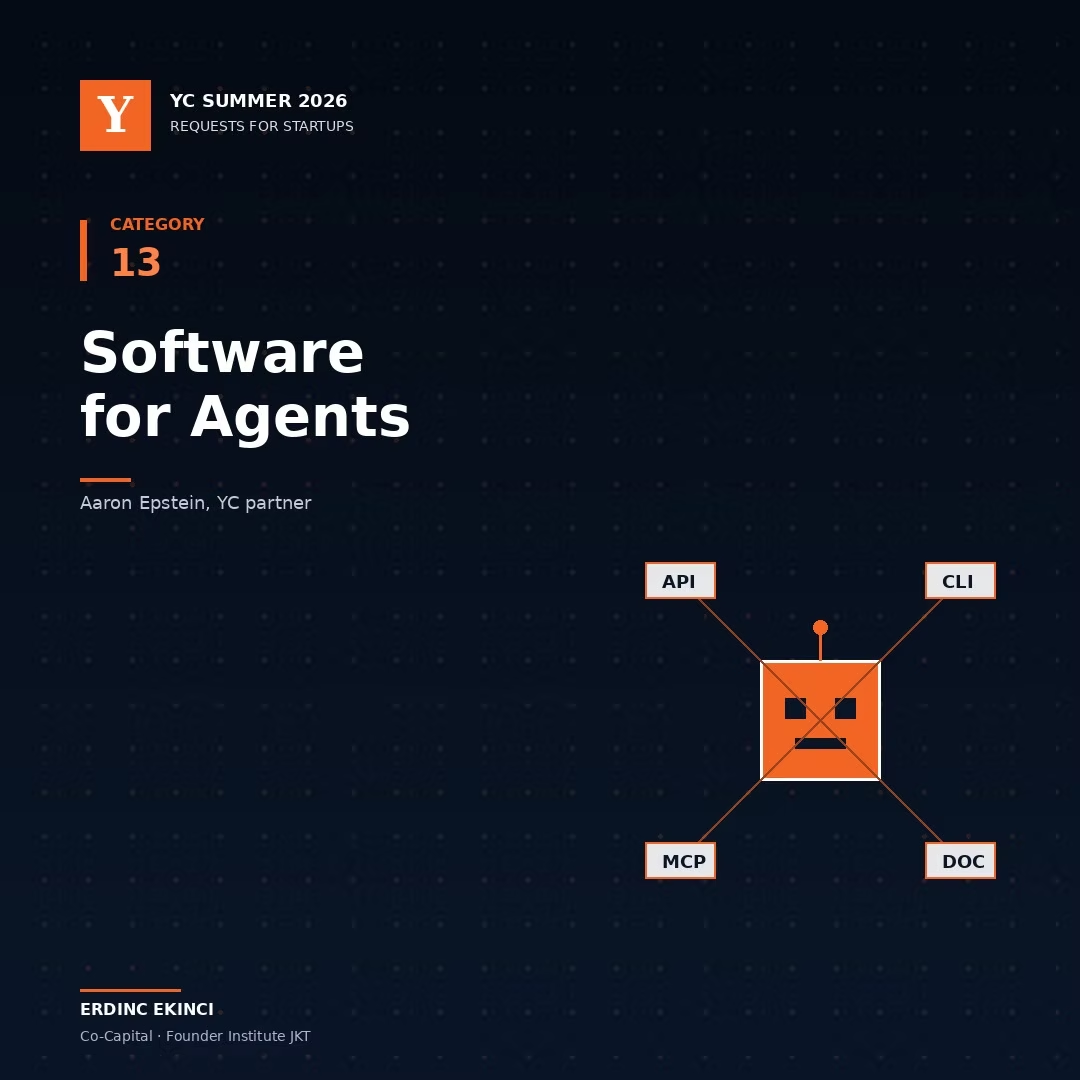
Epstein's framing: the next trillion users on the internet are not people. The protocol layer is consolidating fast. The Linux Foundation's Agentic AI Foundation has the platinum members all signed on. Founders building agent-first software face a choice: build on this stack, or compete against it.
"The next trillion users on the internet won't be people, they'll be AI agents. And now is the time to 'Make Something Agents Want.'" — Aaron Epstein, ycombinator.com/rfs
By the numbers
8 platinum members of Linux Foundation's Agentic AI Foundation (Source: Linux Foundation press release, December 2025)
60,000+ open source projects using OpenAI's AGENTS.md by late 2025 (Source: Linux Foundation press release)
5,000+ community-contributed MCP servers by May 2025 (Source: agnt.one)
Anthropic, Google, Microsoft, OpenAI, AWS, Block, Bloomberg, Cloudflare AAIF platinum members (Source: Linux Foundation press release)
What YC is actually pointing at
Epstein's spec: every major category of software people use today needs to be rebuilt for agents. Machine-readable interfaces (APIs, MCPs, CLIs), thorough machine-readable documentation, ability for agents to discover, sign up, and start using new tools programmatically without humans in the loop.
The protocol layer crystallized in record time
Anthropic introduced MCP in November 2024. Within 16 months, MCP became the de facto standard. By April 2026, the Linux Foundation's Agentic AI Foundation had nearly 150 member organizations. Platinum members include AWS, Anthropic, Block, Bloomberg, Cloudflare, Google, Microsoft, and OpenAI. By May 2025, the official MCP community directory listed over 5,000 servers. OpenAI officially adopted MCP in March 2025. Google announced official MCP support across BigQuery, GCE, GKE, Maps, and Apigee in December 2025.
Commerce protocols are arriving
Visa, Mastercard, PayPal, and Google have all launched protocols for AI agents to make purchases on behalf of users. Visa stated 2025 would be "the final year consumers shop and checkout alone." Foundation Capital's prediction for 2026: "A new pay-to-play layer will emerge where placement isn't just about ranking in search results, but about being surfaced inside an agent's decision flow."
What I'm watching for
Software for agents is largely infrastructure, which is hard to monetize as a startup. Big winners may be the incumbents who already own the rails: Stripe, Visa, Salesforce, GitHub.
Security is real and growing. "The S in MCP stands for security" essay outlined attack vectors including tool poisoning and cross-server tool shadowing.
Protocol stewardship has shifted to Linux Foundation governance. Founders building proprietary stacks face a choice between standard-compliance and differentiation.
Key sources for this section
anthropic.com (Model Context Protocol)
Linux Foundation press release on Agentic AI Foundation, December 2025
Wikipedia. Model Context Protocol
Google Cloud Blog. Announcing official MCP support for Google services, December 2025
Foundation Capital. Where AI is headed in 2026
14. Selling to Huge Companies
Partners: Harshita Arora and Brad Flora, YC partners
The most explicitly contrarian piece on the list. Arora and Flora are challenging a long-standing PG maxim: startups should sell to other startups. Their argument is that AI broke the equation. F100 buyers are awake, willing to skip procurement, willing to pilot products from two-person teams.
"It's not unusual at all to see a company's first customer be one of the largest companies in the world. The buyers are awake and want to talk." — Harshita Arora and Brad Flora, ycombinator.com/rfs
By the numbers
25%+ Fortune 500 companies using Promptfoo before its OpenAI acquisition (Source: Futurum Group, March 2026)
60% Fortune 500 secured by Casco's AI validation (Source: Extruct AI / YC company directory)
Ford, Komatsu, Lockheed subset of CoLab's Fortune 500 customer roster (Source: ycombinator.com/companies)
$0.5T Fortune 500 outsourced marketing spend per year, one services category (Source: Anup Chamrajnagar via Madrona, March 2026)
What YC is actually pointing at
Arora and Flora's three claims: F100 leaders are out looking for AI teams; small teams can ship nuanced products in months; F100 leaders understand AI strategically and know what to outsource. Their concrete observation: "In the last 3 years for the first time ever we've seen YC companies land pilots and actual multimillion dollar deals within their first year if not during the actual YC batch."
The evidence is in the YC portfolio itself
CTGT, a YC-backed applied AI research lab, is deployed with Fortune 500 companies including Tier-1 financial institutions and global media conglomerates. Cozmo is live with 10+ enterprises including Nestle. Promptfoo, founded in 2024 and acquired by OpenAI in March 2026, was used by 25 percent of Fortune 500 companies before acquisition. CoLab is trusted by Ford, Komatsu, Johnson Controls, GE Appliances, and Lockheed Martin. Casco secures systems for over 60 percent of Fortune 500 companies. Distyl AI raised USD 175 million in September 2025 at USD 1.8 billion valuation, helping Fortune 500 firms become AI-native.
Practitioners describe the playbook
Madrona's March 2026 podcast featured founders from Yoodli (Esha Joshi) and Gradial (Anup Chamrajnagar) selling into Google, SAP, Snowflake, Databricks. Joshi describes scoping pilots at 45-day timeframes with declarative outcomes and aligning on success metrics before procurement enters. Chamrajnagar references that outsourced marketing spend in just the Fortune 500 is about half a trillion dollars per year.
What I'm watching for
Enterprise sales infrastructure (security reviews, MSAs, procurement) is still expensive for two-person teams. Successful pilots routinely die in procurement.
Pilot-to-production conversion rates are still low for AI products. A pilot is not revenue.
The agent insurance market is emerging precisely because procurement teams are asking "who pays if your agent breaks something?" and there is no good answer yet.
Key sources for this section
Madrona. This is How F500 Companies are Buying AI Today, March 2026
ycombinator.com/companies (CTGT, Cozmo, Casco, CoLab profiles)
Futurum Group. OpenAI Acquires Promptfoo, March 2026
Crescendo AI. Latest AI Startup Funding News, 2026
Startup Fortune. Sierra Has $635 Million, $150 Million in ARR, May 2026
15. Supply Chain 2.0 for Semiconductors
Partner: Diana Hu, YC partner
This is the most data-dense piece on the list. A single advanced AI chip goes through 1,400 process steps, crosses a dozen countries, and takes 5 months to build. The supply chain is run on spreadsheets, SAP, and phone calls. The bottleneck is real, public, and acknowledged by industry leadership.
"TSMC's advanced packaging is the single biggest bottleneck in AI compute right now, and NVIDIA has locked up over 60 percent of it. HBM memory is booked through 2026. Export controls change quarterly." — Diana Hu, ycombinator.com/rfs
By the numbers
1,400 steps process steps for a single advanced AI chip (Source: ycombinator.com/rfs)
12 countries geographies a chip crosses end-to-end (Source: ycombinator.com/rfs)
3x demand vs capacity gap acknowledged by TSMC CEO C.C. Wei (Source: AI Certs News, December 2025)
60% HBM memory price surge in Seoul retail during 2025 (Source: AI Certs News, December 2025)
What YC is actually pointing at
Hu wants real-time allocation tracking, multi-tier risk monitoring, export compliance tooling. Her direct line: "You need to understand wafer allocation and packaging constraints at a deep level to build this, which is exactly why it's a startup opportunity and not a feature inside SAP."
Industry leadership has confirmed every claim
TSMC CEO C.C. Wei in Q3 2025 earnings: "Our CoWoS capacity is very tight and remains sold out through 2025 and into 2026." Broadcom in March 2026 confirmed continued constraint into 2026. AI Certs News reported in December 2025 that TSMC capacity remains 3x short of demand and that retail HBM prices in Seoul surged 60 percent during 2025 while GPU lease rates on cloud platforms doubled. Q3 2025 HBM supply was fully allocated through 2026, including HBM3E.
The visibility problem is the startup opportunity
TSMC Chairman Mark Liu: "It is not the shortage of AI chips, it is the shortage of our packaging capacity." The CHIPS Act-funded fabs in Arizona, Texas, Ohio, and New York each need supply chains built nearly from scratch. SK Hynix's USD 15 billion advanced packaging plant in Indiana, Micron's USD 20 billion Idaho investment, Micron's USD 7 billion HBM assembly facility in Singapore, and the SK Hynix-TSMC HBM4 partnership are all responses to the same bottleneck.
What I'm watching for
This is one of the most defensible founder bets on the list because the bottleneck is real, public, and widely acknowledged. The challenge is that selling into TSMC, NVIDIA, SK Hynix, Samsung requires deep relationships and security clearances.
Buyers are strategic, not transactional. Sales cycles are long.
The opportunity may be at second-tier rather than foundry level: AI accelerator designers, OSATs, substrate suppliers, equipment makers all need allocation visibility.
Key sources for this section
FusionWW. Inside the AI Bottleneck: CoWoS, HBM, and 2-3nm Capacity Constraints Through 2027, December 2025
AI Certs News. HBM Supply Crunch, December 2025
EnkiAI. HBM Supply Crisis 2026, February 2026
Astute Group / Broadcom 2026 supply commentary
Silicon Canals. Inside the quiet restructuring of global semiconductor supply chains, March 2026
16. The AI Operating System for Companies
Partner: Diana Hu, YC partner
Hu's closing entry is the closed-loop framing of Tom Blomfield's company brain. Where Blomfield asks for the structured knowledge primitive, Hu asks for the active feedback loop on top: the system that monitors, compares, adjusts, generates specs that agents can execute.
"I've seen teams that do this cut sprint time in half and ship twice as much." — Diana Hu, ycombinator.com/rfs
By the numbers
$26M Rhythms total funding (Greenoaks, Madrona, Accel) (Source: Specter Insights, August 2025)
Closed loop the architectural distinction Hu draws (vs open-loop dashboards) (Source: ycombinator.com/rfs)
Slack, Linear, GitHub, Notion brutal integration work Hu names (Source: ycombinator.com/rfs)
Self-improving Hu's closing term for the system (Source: ycombinator.com/rfs)
What YC is actually pointing at
Hu's diagnosis of the existing gap: "There's no product that connects all this context into a single intelligence layer that can reason across it, flag when engineering is building the wrong thing, or generate specs agents can execute on." Her closing line is the differentiator: "Not another dashboard. The system that turns a company's own artifacts into a self-improving loop."
Existing players are hitting Fortune 500 traction
Bessemer's December 2025 "AI systems of action" roadmap articulates the same gap: AI agents are "offloading much of the manual labor that surrounds an SoR." Specter Insights' YC Fall RFS analysis profiled Rhythms, an AI operating system for companies that "orchestrates the rhythms, recurring meetings, reviews and rituals, that drive execution" with USD 26 million in funding from Greenoaks, Madrona, Accel, and early Fortune 500 pilots.
YC-backed Oki AI markets itself as: "tells you everything you need to know to run your company. By reading your team's code, tickets, messages, and more, Oki delivers personalized and interactive updates daily to you and other leaders." Foaster, also YC-backed, builds "the AI-native consulting firm for AI transformation" using agents to interview employees and map workflows.
The buyer demand is converging
Snowflake Ventures' Harsha Kapre, in TechCrunch's December 2025 prediction piece, forecast 2026 spending on "strengthening data foundations, model post-training optimization, and consolidation of tools." Asymmetric Capital's Rob Biederman predicted the broader enterprise landscape will narrow AI spending to a handful of vendors.
What I'm watching for
Microsoft (Copilot Studio), Google (Gemini for Workspace + Apigee MCP), and ServiceNow are pursuing the same outcome from incumbent positions.
The closed-loop framing implies write-access and decision-making, which carries liability questions. Agent insurance startups are emerging precisely because of unresolved enterprise legal exposure.
Diana Hu owning three categories (chips, semiconductor supply chain, AI OS) signals where she expects to spend her partner time. If you are building any of these, she is the partner reading your application.
Key sources for this section
Bessemer Venture Partners. Roadmap: AI systems of action, December 2025
Specter Insights. 1000+ YC Requested Startups Fall 2025, August 2025
TechCrunch. VCs predict enterprises will spend more on AI in 2026, December 2025
ycombinator.com/companies (Rhythms, Oki AI, Foaster, Cassidy)
What this list tells us, taken together
1. The hardware turn is real, but YC's leverage is limited
Eight of the sixteen categories require hardware, capital, or both. YC's standard investment is a USD 500K SAFE. Hardware-led startups need orders of magnitude more. The path YC is charting: back founders early, then route them to deep-pocketed Series A leads who specialize in deep tech (Lux Capital, Founders Fund, General Catalyst, a16z, Benchmark, EQT Ventures, Sequoia). Starcloud's USD 200 million total raise after a USD 500K YC SAFE is the model.
2. Founder-authored entries signal a new YC pattern
Two of the sixteen entries (Electronics in Space, Industrial Capabilities in Space) are signed by founders of an existing YC company (Starcloud), not by YC partners. This is unusual. It suggests YC is using its RFS to amplify portfolio companies' market-creation efforts, implicitly endorsing them as category winners while soliciting complementary startups. I expect more founder-authored entries in future batches.
3. Diana Hu's three entries are the most technically detailed
Hu authors Inference Chips for Agent Workflows, Supply Chain 2.0 for Semiconductors, and AI Operating System for Companies. They are also the most data-rich entries. This is a meaningful signal of where she expects to spend her partner time.
4. The AI-native services category is not a YC-only thesis
General Catalyst (USD 1.5B), Mayfield (USD 100M), Sequoia (Bek), and Elad Gil have publicly committed capital to the same idea. Founders entering should expect significant competition not just from other startups but from the rollup-and-AI-ify model that established VCs are pursuing aggressively.
5. Geopolitics is a recurring undercurrent
Counter-Swarm Defense, Hardware Supply Chain, Supply Chain 2.0, Electronics in Space, and Industrial Capabilities in Space all touch national-security or industrial-policy considerations. CHIPS Act, export controls, Replicator Initiative, Ukraine's drone war, Artemis Program, and tariff regimes are all part of the operating environment. Founders should expect their fundraising and hiring to be affected by ITAR, CFIUS, FOCI, and sovereign procurement frameworks.
6. The protocol layer (MCP, A2A, AGENTS.md) consolidated faster than expected
The Linux Foundation's Agentic AI Foundation, formed December 2025, has put MCP, goose, and AGENTS.md under shared governance with founding members from AWS, Anthropic, Block, Bloomberg, Cloudflare, Google, Microsoft, and OpenAI. Founders building software for agents now face the choice of building on this stack or competing with it.
7. What is NOT on the list is also a signal
Compared to Spring 2026, the Summer list omits AI for product management, AI-native hedge funds, government AI, stablecoins, AI-native legal tech, voice agents and AI receptionists, and consumer robotics. The absence does not mean YC will not fund those, but it tells you where partner attention is concentrated this cycle.
How I built this and how to read it
What is in this report
All 16 categories from YC's official Summer 2026 RFS, including AI-Native Discovery Engines (which was missing from the most-circulated screenshot)
Direct attributed quotes from each category's named partner
Independent sources for every market claim, including peer-reviewed research, government filings, market research firms, and trade press
Open questions and counterpoints I could not resolve
Key sources for further reading at the end of every section
What is NOT in this report
Investment advice or solicitation
Endorsements of specific startups
Commitments by Co-Capital, Founder Institute, or any partner organization
Predictions about which categories will produce the most billion-dollar outcomes
Source priority
Where YC has cited evidence in its own write-up, I quote them and attribute to ycombinator.com/rfs. Where they have not, my source priority is:
Government agencies and peer-reviewed publications (EPA, FDA, NASA, Nature, Royal Society, NCBI/PMC)
Named market research firms (MarketsandMarkets, Marketintelo, Research Nester, BIS Research, Mordor Intelligence)
Established trade and business press (TechCrunch, CNBC, BioPharma Dive, Inside Unmanned Systems, CSIS, Foundation Capital, Bessemer, a16z)
Founder, partner, or company self-published claims (carbonrobotics.com, ecorobotix.com, Anthropic, NVIDIA developer blog, Madrona, Sequoia)
Recommended reading posture
For founders evaluating any of the 16 categories, my recommendation is:
First, read YC's framing as the lens of the partner who would evaluate your application. Their write-up tells you what story they want to hear in the application.
Second, evaluate the underlying market on its own merits using the sources cited herein. The market mostly does not care which RFS list it is on.
Third, build with eyes open to the counterpoints raised in each category section. The counterpoints are not reasons to stop. They are the questions a serious due-diligence investor will ask after the warm intro.
Independent reporting. Not investment advice. Not a solicitation.
Erdinc Ekinci · Co-Capital · Founder Institute Japan, Korea & Taiwan · Openfor.co